You are standing at the edge of a freshly excavated formwork, staring at the dirt, wondering just how many bags of mix or cubic yards of ready-mix truck delivery you actually need to order. Pouring concrete leaves zero room for guessing; run short mid-pour and you face a cold joint and ruined finish, while ordering too much leaves you with expensive, rock-hard waste. So, how do you perform an accurate concrete volume calculation before making that supplier call?
To calculate concrete volume, measure the length, width, and thickness of your pour in feet, multiply them together to find the total cubic feet, and divide by 27 to convert the result into cubic yards. For a standard 4-inch thick slab measuring 10 feet by 10 feet, you need 33.3 cubic feet, which equals approximately 1.24 cubic yards of concrete, plus an extra 5 to 10 percent for waste and uneven subgrade depth.
Getting the math right prevents costly project delays and financial waste. Whether you are pouring a backyard patio, setting fence posts, or building a structural foundation, mastering this measurement process saves money and keeps your project moving forward without frustrating interruptions.
Understanding the Basic Concrete Volume Formula
Every concrete project relies on one fundamental geometric rule: volume equals length multiplied by width multiplied by thickness (or depth). The core challenge for most builders is unit conversion. Because construction dimensions are almost always taken in inches and feet, but concrete is sold by the cubic yard, you must bridge the gap between these two measurement systems correctly.
To use the standard formula, every dimension must be converted into feet or fractions of a foot before you multiply. For example, a thickness of 4 inches is not 4; it is 4 divided by 12, which equals 0.333 feet. A thickness of 6 inches is 0.5 feet. Multiplying length in feet by width in feet by thickness in feet gives you total cubic feet. Because one cubic yard contains 27 cubic feet (3 feet by 3 feet by 3 feet), you divide your total cubic feet by 27 to find the required cubic yards.
When planning your material needs, you can verify your manual math instantly using our Concrete Calculator to ensure your numbers match up before placing an order. Double-checking your figures twice prevents costly miscalculations on delivery day.
How to Measure Length, Width, and Depth

Accurate volume calculations start with precise field measurements. Even a minor error in measuring depth across a large area will result in a massive surplus or shortage of material. Grab a reliable steel tape measure and take multiple readings across your formwork.
For slabs and pads, measure the inside dimensions of your wooden forms rather than the outside edges, as the forms dictate the exact boundaries of the hardened concrete. Measure the depth at several different points across the excavated area. Subgrades are rarely perfectly flat, and a dip in the middle of your sub-base can swallow several extra bags or cubic feet of mix without your noticing.
Try Our Free Calculators:
Handling Irregular Shapes and Footings
Not every project is a neat rectangle. If your pour features L-shapes, circular pads, or stepped footings, you must break the layout down into simpler geometric shapes. Calculate the volume of each individual rectangle or circle separately, then add all the volumes together to find your grand total.
For circular shapes like pier holes or cylindrical columns, the formula changes slightly. You measure the diameter, divide by two to find the radius, square that radius, multiply by pi (approximately 3.1416), and then multiply by the depth. For deep cylindrical footings, you can use our Post Hole Concrete Calculator to determine precise bag counts without getting bogged down in complicated pi calculations.
Converting Cubic Feet to Cubic Yards
Once you multiply your length, width, and depth in feet, the resulting number represents cubic feet. Because ready-mix concrete suppliers sell truckloads by the cubic yard, knowing how to convert this unit is essential for bulk ordering. The conversion factor is always 27.
Suppose your calculated volume is 135 cubic feet. Dividing 135 by 27 gives you exactly 5 cubic yards. If your division yields a decimal remainder, such as 3.42 cubic yards, you will need to round up or order partial yard increments depending on your supplier’s delivery policies. Most ready-mix companies deliver in quarter-yard or half-yard increments.
| Cubic Feet | Cubic Yards | Equivalent 80 lb Bags |
|---|---|---|
| 27 cu ft | 1.0 cu yd | 45 bags |
| 54 cu ft | 2.0 cu yd | 90 bags |
| 81 cu ft | 3.0 cu yd | 135 bags |
| 108 cu ft | 4.0 cu yd | 180 bags |
Estimated Concrete Volume by Slab Size (4 Inch Depth)
Chart note: Values show net cubic yard requirements including a standard 7 percent waste allowance.
These figures provide a reliable baseline for planning, though actual requirements shift based on your specific waste margins. Keep in mind that delivery minimums often apply for small truckloads, which may influence whether you mix bags on-site or order ready-mix delivery.
Calculating Concrete Bag Requirements

For smaller projects like sidewalk repairs, shed pads, or fence posts, ordering a full truckload is impractical and expensive. In these cases, you will mix pre-bagged dry concrete mixes, which are commonly sold in 40-pound, 60-pound, and 80-pound bags at home improvement centers.
To find out how many bags you need, you first calculate the total cubic yards or cubic feet required, then divide by the yield of a single bag. Standard pre-mixed concrete yields roughly the following volumes:
Also Read:
- Concrete Calculator: How Much Concrete Do You Need in 2026?
- How Much Does Concrete Cost Per Yard in 2026? Pricing, Delivery & Labor
- How Much Does a Concrete Patio Cost in 2026? Pricing, Labor & Materials
- How to Calculate Gravel for a Driveway: A Step-by-Step Guide for 2026
- Tile Quantity Calculator Guide: How to Calculate Materials and Waste for 2026
- 40-pound bag: Yields approximately 0.011 cubic feet (requires about 90 bags per cubic yard).
- 60-pound bag: Yields approximately 0.045 cubic feet (requires about 60 bags per cubic yard).
- 80-pound bag: Yields approximately 0.060 cubic feet (requires about 45 bags per cubic yard).
For any moderate DIY project, 80-pound bags offer the best balance of value and handling efficiency. If you are mixing dozens of bags by hand or with a motorized mixer, you can cross-check your material totals using our Concrete Bags Calculator to avoid running out before the forms are full.
Factoring in Waste and Subgrade Variations

No concrete calculation is complete without adding a waste and spillage factor. Subgrades settle, wooden forms bow outward under the immense hydraulic pressure of wet concrete, and some material inevitably sticks to the sides of wheelbarrows, mixer drums, or chutes.
Industry standard practice is to add a 5 to 10 percent waste allowance to your calculated volume. For a standard flatwork slab over a well-compacted gravel base, 5 percent is usually sufficient. For rough excavations, earth floors, or complex formwork where subgrade irregularities are common, bump that safety margin up to 10 percent.
For complex structural pours or uneven terrain, running your numbers through our Concrete Slab Calculator helps account for standard safety margins and prevents unexpected material shortages on pour day.
Step-by-Step Worked Calculation Example

Let us walk through a practical, real-world scenario. Imagine you want to pour a backyard concrete patio that measures 12 feet long by 15 feet wide, with a standard thickness of 4 inches.
First, convert the thickness from inches to feet: 4 inches ÷ 12 = 0.333 feet. Next, multiply your three dimensions together: 12 ft (length) × 15 ft (width) × 0.333 ft (depth) = 60 cubic feet. Now, convert cubic feet to cubic yards by dividing by 27: 60 ÷ 27 = 2.22 cubic yards.
Finally, add a 7 percent waste allowance for subgrade settling and form deflection: 2.22 × 1.07 = 2.38 cubic yards. If you decide to pour this project using pre-mixed bags, you multiply 2.38 cubic yards by 45 bags per yard, which tells you that you need to purchase 108 of the 80-pound bags.
Common Mistakes in Concrete Volume Calculation
Even experienced builders occasionally trip up on simple arithmetic or measurement errors when estimating concrete volume. Being aware of these common pitfalls protects your budget and your finished project quality.
- Mixing units of measurement: Forgetting to convert inches into feet before multiplying is the single most frequent calculation error, resulting in wild overestimates or disastrous shortages.
- Ignoring subgrade depth variations: Assuming your excavation is uniform in depth leads to under-ordering when low spots consume extra material.
- Forgetting form deflection: Wooden side forms can bow outward under heavy wet concrete, increasing the internal volume of the formwork beyond your initial measurements.
- Failing to account for rebar volume: While steel rebar displaces a tiny amount of concrete, major structural elements with dense steel cages require minor volume adjustments.
Tips for Ordering and Managing Concrete Deliveries

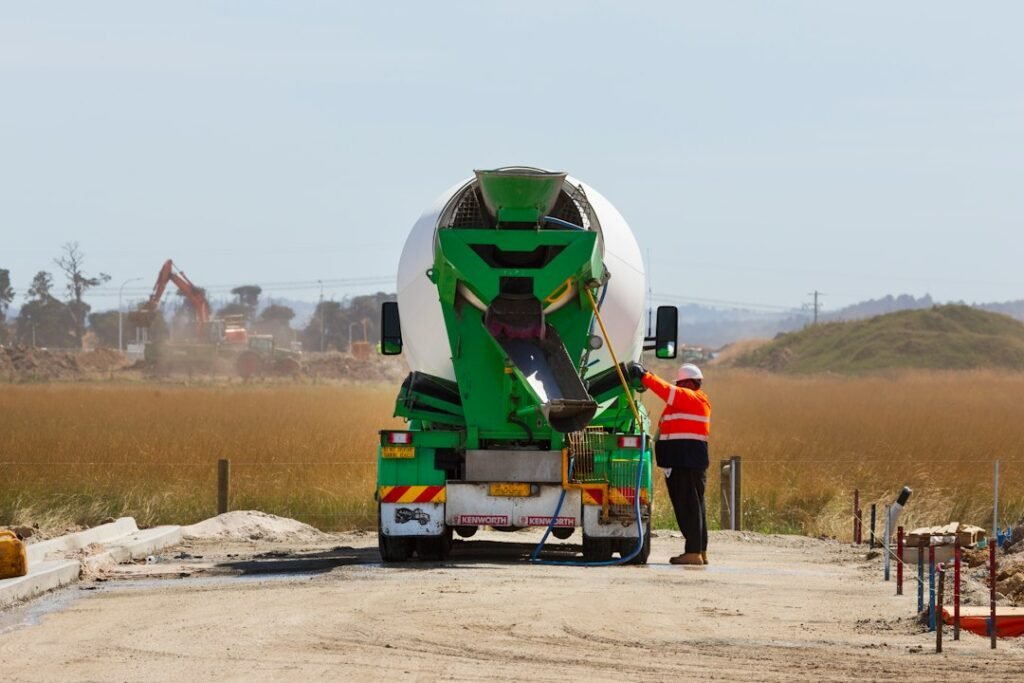
Once you have completed your concrete volume calculation, managing the delivery logistics ensures a smooth pour. Whether your concrete arrives in a massive transit mixer or you mix it on-site in small batches, preparation is everything.
Ensure your site is fully prepped, forms are braced securely, and sub-base gravel is compacted before the truck arrives. Ready-mix suppliers typically allow a set amount of free unloading time (usually 45 to 60 minutes) before charging heavy demurrage fees per minute. Having wheelbarrows, shovels, screed boards, and finishing tools ready and positioned makes all the difference.
For projects requiring multiple concrete trucks or specialized foundation pours, consulting tools like our Concrete Foundation Calculator helps you plan phase deliveries and structural volumes accurately.
Pros and Cons of Ready-Mix vs. Bagged Concrete
Choosing between ready-mix truck delivery and buying individual bags depends entirely on your calculated volume, site access, and labor availability.
- Ready-Mix Concrete Pros: Delivers consistent batch quality, saves immense physical labor, handles large volumes quickly, and finishes smoothly.
- Ready-Mix Concrete Cons: High delivery minimum fees for small loads, strict truck access requirements, and potential idle charges if your crew moves slowly.
- Bagged Concrete Pros: Perfect for small or remote projects, allows flexible working speeds, and eliminates truck minimum delivery fees.
- Bagged Concrete Cons: Extremely strenuous manual labor, inconsistent water-to-mix ratios if hand-mixed carelessly, and higher per-cubic-yard material costs.
Final Takeaway
Mastering concrete volume calculation is the cornerstone of any successful masonry or flatwork project. By accurately measuring length, width, and depth in feet, dividing by 27 to find cubic yards, and factoring in a sensible waste allowance, you eliminate guesswork and protect your project budget.
- Always convert inches to feet before multiplying your project dimensions.
- Divide total cubic feet by 27 to find your required cubic yards for bulk ordering.
- Add a 5 to 10 percent waste allowance to account for subgrade settling and form bow.
- Utilize professional calculation tools to verify your numbers before ordering materials.
Precision in your math prevents costly cold joints, emergency supply runs, and wasted material. For your next project, leverage BuildCost.online’s suite of planning tools to ensure accurate estimates, and always verify final requirements with your local ready-mix supplier or contractor.
Disclaimer: Concrete volume estimates and planning ranges vary based on exact site conditions, subgrade compaction, formwork deflection, and local supplier practices; always verify calculations and order quantities on-site before pouring.
Frequently Asked Questions
How do you calculate concrete volume in cubic yards?
Multiply the length, width, and depth (all in feet) to get cubic feet, then divide that total by 27. For example, a 10×10 foot slab that is 4 inches (0.333 ft) thick equals 33.3 cubic feet, which divided by 27 gives 1.24 cubic yards.
How many 80 lb bags of concrete make one cubic yard?
It takes approximately 45 bags of 80-pound pre-mixed concrete to yield one cubic yard of mixed concrete. For 60-pound bags, you will need about 60 bags per cubic yard.
How much extra concrete should I order for waste?
You should add a 5 to 10 percent waste allowance to your calculated volume. Use 5 percent for level sub-bases on flatwork, and 10 percent for rough excavations, earth floors, or complex formwork where subgrade dips are common.
How do I calculate concrete for a circular pier or post hole?
Measure the diameter of the hole in feet, divide by two to get the radius, square that number, multiply by pi (3.1416), and then multiply by the depth in feet to get cubic feet. Divide by 27 to get cubic yards.
What is the standard thickness for a concrete driveway or patio?
A standard residential patio or sidewalk is typically poured 4 inches thick. Driveways and parking pads carrying heavier vehicle loads should be poured at least 5 to 6 inches thick with reinforced wire mesh or rebar.
Can I mix concrete by hand if my project is large?
Mixing anything more than half a cubic yard (about twenty 80-pound bags) by hand is extremely labor-intensive and difficult to complete before the mix begins to set. For larger volumes, renting a motorized mixer or ordering ready-mix truck delivery is strongly recommended.
What happens if I run short of concrete during a pour?
Running short creates a major headache because ready-mix trucks cannot arrive instantly, and concrete begins setting within 60 to 90 minutes. This causes cold joints that weaken the slab structurally, which is why accurate volume calculation and waste allowances are critical.
Final Takeaway
Calculating concrete volume accurately is essential for keeping your construction budget on track and avoiding the disastrous consequences of running short mid-pour. By following standard geometric formulas and incorporating a safe waste margin, you ensure structural integrity and flawless results.
- Always convert all measurements into feet before multiplying length, width, and depth.
- Divide total cubic feet by 27 to determine the required cubic yards for bulk orders.
- Add 5 to 10 percent for waste, spillage, and uneven subgrade depth.
The single biggest variable in concrete volume estimation is subgrade depth accuracy; even minor dips in the excavated earth will consume unexpected extra material. For quick and reliable estimates on your next project, use BuildCost.online’s comprehensive calculator tools and always confirm your measurements before ordering.
Estimates vary by location, supplier, and site conditions and should be verified locally before ordering materials.