How Many Bags of Concrete Do I Need?
You are standing in the aisle of a home improvement store, staring at rows of heavy grey paper sacks, wondering how many bags of concrete your weekend project actually requires. Running short mid-pour is a backbreaking disaster, while buying too many leaves you with heavy, ruined pallets you cannot return. Finding that exact sweet spot of material takes simple math, accurate measurements, and an understanding of how bag sizes translate into volume.
To answer the core question directly: You need approximately 45 80-lb bags of concrete to pour a 4-inch thick, 100-square-foot slab. For smaller projects, a standard 2-foot deep, 10-inch diameter post hole requires about three 80-lb bags. Because calculating exact cubic footage can get confusing when converting inches to feet, using a dedicated tool like the bags of concrete calculator makes the process foolproof before you load up your truck.
Calculating material volume accurately depends entirely on measuring your length, width, and depth in feet, then dividing the total cubic volume by the yield of your chosen bag size. Standard bags come in 40-lb, 60-lb, and 80-lb weights, each yielding a specific fraction of a cubic foot. Knowing these yields prevents guesswork, saves your budget, and ensures your footings, pads, or walkways achieve full structural strength without unnecessary waste.
Understanding Concrete Bag Yields and Sizes

Before doing any math, you need to know how much physical space a single bag of dry mix actually occupies once mixed with water. Manufacturers design bags to yield predictable cubic footage, though the exact yield varies slightly depending on whether you are using standard high-strength mix, rapid-setting concrete, or lightweight formulations. Standard concrete mix yields are the baseline for nearly all residential DIY projects.
An 80-pound bag of standard concrete yields approximately 0.60 cubic feet of mixed material. A 60-pound bag yields about 0.45 cubic feet, and a smaller 40-pound bag yields roughly 0.30 cubic feet. These numbers are critical because you must match your project’s total volume in cubic feet against these specific yields to determine your total bag count.
When planning your purchase, remember that handling heavier bags requires more physical effort, but they offer a much lower cost per cubic foot. Many builders prefer 80-pound bags for large flatwork because they require fewer total trips and less handling per cubic yard. However, if you are working alone or lifting materials into elevated forms, 60-pound bags strike a more manageable balance between weight and project efficiency.
| Bag Size | Dry Weight | Approximate Yield | Bags per Cubic Yard |
|---|---|---|---|
| Small Bag | 40 lb | 0.30 cu. ft. | 81 bags |
| Medium Bag | 60 lb | 0.45 cu. ft. | 54 bags |
| Large Bag | 80 lb | 0.60 cu. ft. | 41 bags |
These planning estimates provide a solid baseline for purchasing materials at your local supplier. Actual yields can fluctuate slightly based on how much water you mix into the batch and whether aggregate settles heavily during transport. Always round up your final count to account for uneven sub-grade excavations.
How to Calculate Cubic Footage for Your Project

Calculating the volume of your project is the foundational step before you can figure out bag counts. You must measure length, width, and depth in feet. If your measurements are in inches, divide them by 12 to convert them into decimals before multiplying.
The standard formula for rectangular slabs, footings, or pads is multiplying Length (in feet) times Width (in feet) times Depth (in feet). For example, if you are pouring a concrete slab that is 10 feet long, 10 feet wide, and 0.33 feet thick (which equals 4 inches), your calculation is 10 x 10 x 0.33, resulting in 33 cubic feet of total volume.
Once you have your total cubic footage, you divide that number by the cubic foot yield of your chosen bag size. Continuing our example with 80-pound bags yielding 0.60 cubic feet each, you divide 33 by 0.60, which equals 55 bags. Adding a standard 10% waste factor brings your total shopping list to 61 bags.
Try Our Free Calculators:
Concrete Bag Requirements by Slab Thickness

Slab thickness dictates the vast majority of concrete purchases for residential patios, walkways, and shed pads. A standard sidewalk or residential patio typically requires a 4-inch thickness, while driveways or areas supporting heavy vehicles demand 5 to 6 inches of structural depth to prevent cracking under load.
When preparing your sub-grade, keep in mind that excavating an extra inch of soil to reach proper depth dramatically increases the number of bags you must haul and mix. If you miscalculate your depth by just one inch across a large patio, you could find yourself dozens of bags short halfway through your pour.
For a quick reference during your initial planning phase, you can cross-reference common square footage areas with required 80-lb bag counts for standard 4-inch thick pours. If you want to check custom dimensions instantly, our calculator lets you input exact figures for any irregular shape or depth.
| Project Area (Sq. Ft.) | Depth (Inches) | Total Cubic Feet | 80-lb Bags Needed (No Waste) |
|---|---|---|---|
| 50 sq. ft. | 4 inches | 16.7 cu. ft. | 28 bags |
| 100 sq. ft. | 4 inches | 33.3 cu. ft. | 56 bags |
| 200 sq. ft. | 4 inches | 66.7 cu. ft. | 111 bags |
| 300 sq. ft. | 4 inches | 100.0 cu. ft. | 167 bags |
| 500 sq. ft. | 4 inches | 166.7 cu. ft. | 278 bags |
80-lb Bags Needed by Project Size (4-Inch Slab)
Chart note: Estimated bag counts include a standard 10% waste factor for 4-inch thick concrete slabs placed on level sub-bases.
These figures assume a flat, level sub-base with zero grade depressions. If your compacted gravel base has dips or ruts, the concrete will pool into those low spots, consuming your reserve bags much faster than anticipated.
Calculating Concrete for Post Holes and Footings

Setting fence posts, deck piers, or structural footings requires a completely different calculation method than flat slabs. Instead of rectangular volumes, you are calculating the volume of a cylinder using the formula for circular areas: Pi (3.14) times radius squared times depth.
For a standard fence post hole measuring 10 inches in diameter and 24 inches (2 feet) deep, the calculation requires converting the radius to feet (5 inches = 0.416 feet). Multiplying 3.14 x (0.416 x 0.416) x 2 gives you roughly 1.08 cubic feet of volume. Dividing this by an 80-lb bag yield means you need about two bags per hole.
When digging post holes in expansive clay soils or frost-prone regions governed by local building codes, footings often need to flare out at the bottom into a bell shape or extend below the local frost line. Failing to account for these widened bell-footings is the number one reason DIY builders run out of concrete before filling their post holes.
How to Calculate Material for Concrete Steps and Stairs
Pouring concrete steps is notoriously tricky because stairs are essentially a series of stacked triangular or rectangular wedges. You must break down each step into individual geometric sections, calculate the volume of each step separately, and then add them all together.
A typical set of three porch steps with a 3-foot width, 10-inch run, and 7-inch rise requires calculating the volume of the bottom step, the middle step, and the top landing independently. Once you sum these volumes into cubic feet, you divide by your bag yield just like any other flatwork project.
Because formwork for stairs involves complex wooden bracing and exact leveling, taking precise measurements of the rise and run is critical to avoid awkward step heights that violate local IRC residential building codes. For multi-tier steps, utilizing specialized estimation tools helps break down complex stair geometries into manageable bag totals.
Also Read:
- How to Calculate Concrete Volume: Step-by-Step Guide for DIYers and Contractors
- Concrete Calculator: How Much Concrete Do You Need in 2026?
- How Much Does Concrete Cost Per Yard in 2026? Pricing, Delivery & Labor
- How Much Does a Concrete Patio Cost in 2026? Pricing, Labor & Materials
- How Many Gallons of Paint Do I Need? Room & House Estimating Guide
Step-by-Step Guide to Estimating Any Custom Shape
When dealing with L-shaped patios, circular fire pit pads, or irregularly curved landscape borders, standard rectangular math fails. Breaking complex footprints into manageable geometric shapes ensures your material order remains accurate.
- Sketch your footprint. Draw your project area on paper and divide complex shapes into simple squares, rectangles, and triangles.
- Take accurate field measurements. Measure each sub-section in feet and record the dimensions directly onto your sketch.
- Calculate individual areas. Compute the square footage of each geometric piece independently.
- Determine total volume. Multiply each area by your uniform depth in feet to get individual cubic foot values, then add them together.
- Apply bag yields. Divide your grand total of cubic feet by the yield of your chosen bag size.
The Importance of Adding a Waste Factor
No concrete calculation is 100% precise in the real world. Sub-grades sink under the weight of wet concrete, wooden forms bow outward under hydrostatic pressure, and a small amount of mix inevitably remains stuck inside your mixer drum or wheelbarrow.
Adding a waste factor is not optional if you want to finish your project in one continuous pour. Industry standards recommend adding 5% to 10% extra material for flat slabs placed on well-compacted gravel, and up to 15% extra for irregular footings, trenches, or rough excavated earth.
If your calculation shows you need 50 bags of concrete, buying 55 bags ensures you won’t get caught with a half-finished slab when the local hardware store closes. Unused dry bags in unbroken paper sacks can almost always be returned, making a minor over-purchase far better than a costly emergency run for extra material.
Converting Bags to Cubic Yards for Large Projects

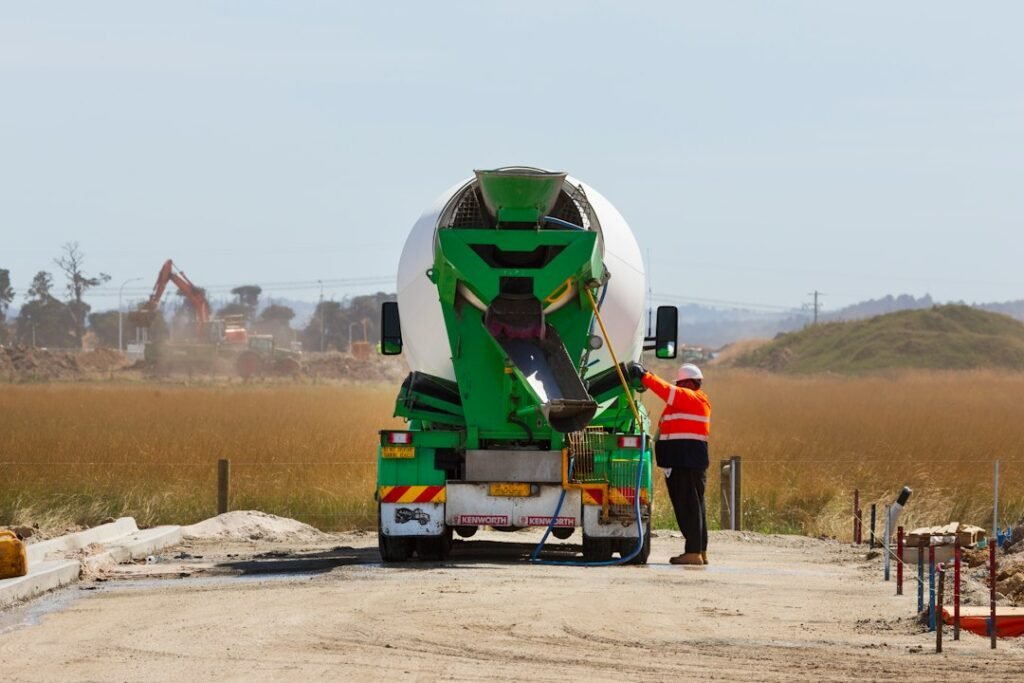
When a project starts requiring more than 40 or 50 bags of concrete, mixing by hand or in a small electric mixer becomes physically exhausting and time-consuming. At that threshold, purchasing bulk ready-mix truck delivery becomes much more practical and often cheaper.
To convert your bag count or cubic footage into cubic yards—the standard unit for truck delivery—you divide your total cubic feet by 27. For example, a project requiring 135 cubic feet of concrete divided by 27 equals exactly 5 cubic yards.
As a general rule of thumb, any project requiring more than 60 to 85 80-pound bags (roughly 2 to 3 cubic yards) crosses the threshold where ordering a ready-mix truck makes more sense than mixing individual bags. For complex site layouts, checking local supply rates alongside material estimates helps clarify the transition point between bagged mix and truck delivery.
Cost and Material Breakdowns for Common Projects
Budgeting for concrete involves balancing material costs, equipment rentals, and delivery fees. Understanding typical financial outlays helps prevent unexpected expenses during construction.
- Backyard Walkway (50 sq. ft. at 4 inches thick): Requires roughly 28 80-lb bags. At average retail pricing, material costs range between $140 and $180, excluding forms and sub-base gravel.
- Shed Foundation Pad (100 sq. ft. at 4 inches thick): Requires about 56 80-lb bags. Expect material costs between $280 and $360, plus the cost of a rented drum mixer if you are mixing by hand.
- Medium Patio Slab (200 sq. ft. at 4 inches thick): Requires approximately 111 80-lb bags. At this scale, material costs approach $550 to $700. Consider comparing this total against local ready-mix minimum load charges.
Pros and Cons of Using Bagged Concrete
Choosing between bagged concrete mixes and ordering bulk ready-mix delivery depends on your project scale, site access, and physical labor capacity. Understanding the distinct advantages and disadvantages of bagged mix helps set realistic expectations for your build.
- Flexibility for remote or tight access sites. Bagged concrete can be transported manually or via wheelbarrow to backyards where concrete trucks cannot drive.
- Controlled pacing for DIY builders. You can mix small batches at your own speed, making it ideal for solo workers or intricate formwork.
- No minimum load fees. Unlike ready-mix companies that charge steep fees for partial truck loads under 3 to 5 cubic yards, you only buy what you need.
- Extremely high physical labor required. Lifting, ripping open, dumping, and mixing dozens or hundreds of heavy bags is grueling physical work.
- Inconsistent batching risks. Mixing bags individually across a large multi-batch pour can lead to slight color variations and uneven curing strength if water ratios fluctuate.
- Higher cost per cubic yard. Buying concrete in paper bags costs significantly more per cubic yard than purchasing bulk ready-mix from a local batch plant.
Common Mistakes When Calculating Concrete Bags
Even experienced builders occasionally stumble when estimating material requirements. Avoiding these frequent calculation errors ensures your project goes smoothly from the initial stakeout to the final trowel finish.
Forgetting the sub-base depth. Many calculations assume concrete sits directly on flat dirt, forgetting that a 4-inch slab requires a mandatory 3-to-4-inch compacted crushed stone base underneath it. Make sure you calculate your excavation depth separately from your concrete pour depth.
Confusing inches and feet. Entering slab thickness in inches directly into multiplication formulas without converting it to a decimal fraction of a foot is the most common mathematical error. Always divide your thickness inches by 12 before multiplying.
Ignoring bag weight fatigue. Estimating that you can personally hand-mix 120 bags of 80-lb concrete in a single afternoon often leads to extreme physical exhaustion and poorly mixed batches by bag number 40. Rent a motorized mixer or split the labor across multiple days if you are working solo.
Failing to account for form deflection. Wooden 2×4 or 2×6 forms can bow outward under the extreme hydrostatic pressure of wet concrete. If your forms push outward by even half an inch across a long span, your calculated volume will fall short.
How to Get an Accurate Concrete Estimate
Gathering precise site data before you buy materials prevents costly mistakes and wasted trips. Follow this simple checklist to ensure your concrete planning is rock solid:
- Measure multiple depth points. Check your form depth with a tape measure every few feet to verify your sub-grade is uniformly graded.
- Account for forms and framing. Measure the inside dimensions of your wood forms, not your outer stakes or string lines.
- Check local building codes. Confirm required slab thickness, reinforcement schedules, and frost line depths with your local municipal building department before purchasing supplies.
- Calculate waste explicitly. Always add a 10% contingency buffer to your final bag count to cover sub-grade settlement and mixing residue.
- Consult specialized estimating tools. Use our concrete calculators to cross-check your manual math against standard industry benchmarks before heading to the store.
Advanced Tips for Pouring and Finishing Concrete Success
Executing a flawless concrete pour requires careful preparation beyond simply calculating the correct number of bags. When working with large volumes of bagged mix, logistics can make or break your project timeline. Coordinating water sources, staging mixing stations close to the formwork, and having the right tools ready before the first bag is opened will keep the workflow efficient and prevent premature setting.
Always assemble your tools ahead of time. You will need a sturdy wheelbarrow or a motorized mixer, a square-point shovel, a garden hose with a spray nozzle, a magnesium float or bull float, an edging tool, and a grooving tool if you are planning control joints. Having helpers is essential if your project exceeds 20 bags; assign one person strictly to opening and dumping bags, another to managing the water hose and mixer, and a third to wheeling and placing the wet concrete into the forms.
Managing water content is another critical factor in structural integrity. Adding too much water makes the concrete easier to pour, but it drastically reduces the cured compressive strength and increases surface cracking. Mix the concrete until it reaches the consistency of thick oatmeal or peanut butter—it should hold its shape when balled in a gloved hand without slumping flat or leaking excess water.
Troubleshooting Concrete Delivery and Mixing Challenges
Even with meticulous planning, unexpected complications can arise during a concrete project. Knowing how to troubleshoot these issues on the fly ensures you can salvage your pour without compromising structural quality.
If your concrete begins setting up too quickly on a hot, windy day, do not dump extra water directly onto the surface to thin it out. Instead, use an evaporation retarder spray or mist the surface lightly while continuously working the material. Rapid drying causes plastic shrinkage cracks that weaken the top layer.
If you realize you miscalculated and are running short by a few bags, remain calm. If you have a nearby hardware store, rapid-setting concrete can be purchased and mixed quickly to tie into your existing wet edge, provided the previous batch has not begun to set hard. Always keep emergency supplies on hand for larger pours to bridge unexpected calculation gaps or localized sub-grade drop-offs.
Frequently Asked Questions
How many 80 lb bags of concrete do I need for a 10×10 slab?
A 10×10 foot slab (100 square feet) poured at the standard 4-inch thickness requires 33.3 cubic feet of concrete. Using standard 80-lb bags that yield 0.60 cubic feet each, you need roughly 56 bags, or 62 bags including a 10% waste factor.
How many 60 lb bags of concrete make a cubic yard?
It takes approximately 54 sixty-pound bags of concrete to equal one cubic yard of mixed material (27 cubic feet). For 80-pound bags, you need about 41 bags per cubic yard.
How many bags of concrete do I need for a 4-inch post hole?
For a standard fence post hole measuring 10 inches in diameter and 2 feet deep, you need about 2 to 3 eighty-pound bags of concrete, depending on how tightly packed the surrounding earth is.
Should I mix concrete by hand or order a truck?
If your project requires fewer than 60 to 80 bags, hand-mixing or renting a small electric mixer is usually practical. For anything requiring over 80 bags (roughly 3 cubic yards), ordering a ready-mix truck saves immense physical labor and often costs comparable amounts.
How much water do I add to an 80 lb bag of concrete?
Most standard 80-lb concrete bags require between 2.5 and 3 quarts (approx. 0.6 to 0.75 gallons) of clean water. Always pour most of the water in first, add the dry mix, and trickle in remaining water slowly to achieve a thick, workable peanut-butter consistency without soupiness.
Why do I need a waste factor when calculating concrete?
A 5% to 10% waste factor accounts for uneven sub-grade excavations, slight bowing in wooden formwork, spilled mix during transport, and material sticking to mixer drums. Without it, you risk running short right before finishing your pour.
Final Takeaway
Calculating how many bags of concrete you need comes down to accurately measuring your project’s length, width, and depth in feet, calculating total cubic volume, and dividing by your bag yield. Proper planning prevents mid-pour shortages and exhausting extra trips to the hardware store.
- 80-lb bag yield: Each bag provides approximately 0.60 cubic feet of mixed concrete.
- 100 sq. ft. slab (4 inches thick): Requires about 56 to 62 eighty-pound bags including waste.
- Post holes: Standard 10-inch by 2-foot holes require 2 to 3 bags each.
- The threshold rule: Pours exceeding 80 bags are usually better suited for ready-mix truck delivery.
Before purchasing materials, verify your dimensions and check local code requirements. For quick, reliable figures, use BuildCost.online’s Concrete Bags Calculator to plan your material purchases accurately and get started on your build with confidence.
Planning estimates and material yields vary by supplier, mix type, and site conditions; verify exact requirements locally before purchasing.